



How do I calculate the P/L (profit or loss) per trade?
Last updated: 12 August 2026
Calculating a position’s profit or loss (P/L) in USD requires a different formula depending on whether the asset is USD-based or non-USD-based
You can find the base currency of any asset on the etoro platform by checking below the ticker symbol:
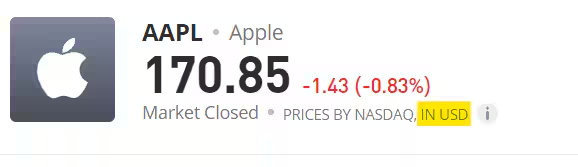
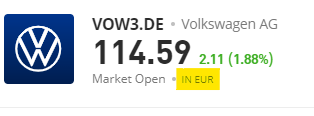
Note: we modified how we calculate the value of non-USD-based real assets on 3 March 2024. Positions opened before and after this date use different formulae to determine the P/L.
Below, you will find the formulae for each of the following kinds of positions you may hold at etoro:
- USD-based assets (real and CFD)
- Non-USD-based real assets opened before 3 March 2024 and CFDs
- Non-USD-based real assets opened on or after 3 March 2024
USD-based assets (real and CFD)
For open trades:
- Buy trade: (current rate - open rate) × units = P/L
- Short trade: (open rate - current rate) × units = P/L
For closed trades:
- Buy trade: (close rate - open rate) × units = P/L
- Short trade: (open rate - close rate) × units = P/L
Non-USD-based real assets opened before 3 March 2024, and CFDs
For open trades:
- Buy trade: (current rate - open rate) × units × USD exchange rate = P/L
- Short trade: (open rate - current rate) × units × USD exchange rate = P/L
For closed trades:
- Buy trade: (close rate - open rate) × units × USD exchange rate = P/L
- Short trade: (open rate - close rate) × units × USD exchange rate = P/L
Non-USD-based real assets opened on or after 3 March 2024
For open trades:
- [(current USD exchange rate × current rate) - (USD exchange rate at the time of opening × open rate)) × units = P/L
For closed trades:
- [(USD exchange rate at the time of closure × close rate) - (USD exchange rate at the time of opening × open rate)] × units = P/L
Stocks on the London Stock Exchange are traded in pence rather than pounds. To calculate the profit or loss for a London stock trade, use the applicable formula above and divide the result by 100.
See our P/L calculation blog post for an in-depth explanation and examples.
Was this article helpful?
Still need help?
We're happy to assist you, whenever you need us. Choose your preferred method of contact.